
Your analytics tells you a visitor showed up and left.
It does not tell you why.
That gap is one of the most expensive blind spots in marketing. You can see that traffic came and bounced, but not what almost worked. Not the button they hovered and never clicked. Not the form field where they gave up. Not the channel that actually sent them. You get a number, and then you get to guess.
We got tired of guessing. So we built our own.
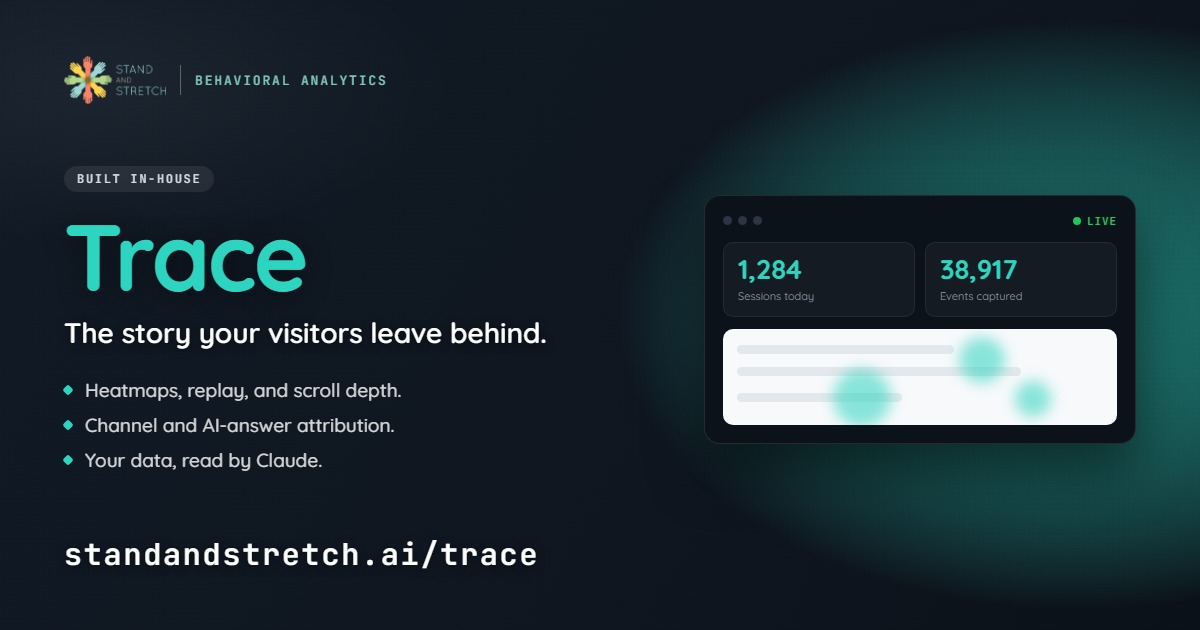
Trace is our behavioral analytics. It watches how real people use your site, and then it explains what it saw.
Most analytics tell you what happened. Trace tells you why.
A count is a symptom. Behavior is the cause. We wanted the cause.
The problem with counting
Counting visits is easy. Every analytics tool does it. The trouble is that a count cannot tell you where your site is leaking.
Say a page gets a thousand visitors and converts ten of them. A normal report stops there. It hands you a percentage and walks away. But the real story is in the nine hundred and ninety people who left, and a count has nothing to say about them.
Did they scroll past your offer because it sat too far down the page? Did they start your form and quit on the phone number field? Did a broken script kill the page on mobile and you never knew? A number cannot answer any of that. Behavior can.
What Trace actually watches
Trace loads after your page paints, so it never slows you down. Behind that one quiet line of code, it is watching nine kinds of behavior at once.
It maps every click. Heatmaps show exactly where people tap, including the rage clicks and dead clicks that signal frustration. It replays sessions in a privacy-safe way so we can watch where someone got stuck, with inputs masked by default. It tracks scroll depth so your most important message never sits below where people stop reading. It watches your forms field by field, so we can see exactly where a form quietly loses you leads.
It also catches the things that cost you sales silently. Performance and Core Web Vitals from real visitors, not a lab test. JavaScript and network errors the moment they happen, so a broken button does not go unnoticed for a month.
None of that is a chart you have to decode. It is the behavior behind the bounce, which is the only thing worth changing.
The channel most tools bury
Here is the part that matters more every month.
Most analytics lump a huge share of your traffic into one useless word: direct. It is the junk drawer of attribution. Email, a podcast mention, a link someone pasted in a text, and the fastest growing source of all, visitors sent by an AI answer, all get swept into the same anonymous pile.
Trace pulls them apart. It separates Google from ads from social from email, and it picks up the new one almost nobody is measuring yet: people who found you because ChatGPT, Perplexity, Claude, or Gemini cited you in an answer.
If you are spending real money on SEO and AEO, you need to know which one is actually sending people who convert. Trace shows you, by source, all the way through to the sale.
Why we built our own instead of renting one
We could have bolted on a generic analytics tool like everyone else. We built Trace instead, for two reasons.
Your data stays under one roof. With most tools, your visitor data lives on someone else’s servers, gets resold, and sometimes gets used to train models you will never benefit from. Trace keeps your data in our system. It is not for sale, and it never will be.
It gets read by Claude, not a generic engine. This is the part that connects Trace to everything else we do. The behavior Trace captures gets analyzed inside our own intelligence layer, the same one running your SEO, your ads, and your strategy. So the insight comes back as a recommendation we can act on this week, not a dashboard you have to interpret on your own. The thinking is human-led. Trace just makes sure the thinking is based on what your visitors actually did.
What that means for you
You do not have to learn a new tool or log into anything. Trace comes built into how we partner with you. We turn it on, it starts reading the story your visitors are leaving behind, and we use what it finds to make your site convert better.
If you want to see exactly what it captures and how it works, the Trace page walks through all of it. And it pairs with Point, the tool we built so giving us website feedback takes one click instead of a long email.
Final take
A visit count tells you that people came. It cannot tell you why they left.
Trace was built to answer the harder question, and to answer it with your own data, read by the same intelligence model that runs the rest of your marketing. Stretch is the thinking. Trace is the telling.
If you want it pointed at your site, that is a conversation. You can start one any time at standandstretch.com.